
Tobacco tax
is an excise duty levied by the customs administration and paid into the federal budget.
After mineral oil tax, tobacco tax is the most profitable excise tax.
The tobacco duty model was first implemented between 2011 and 2015. It provided for a moderate annual increase in tobacco duty on cigarettes and fine-cut tobacco. This model was set out in the Tobacco Duty Modernisation Act. Over a period of five years, starting in 2022, tobacco duty was adjusted in four stages in a moderate manner that allowed all parties to plan ahead.


taxed

tax increases


forecast
The most important changes and innovations of the Tobacco Tax Modernisation Act:
- The tobacco tax model* will be continued from 1 January 2022 with a 4-stage tax increase over 5 years from 2022 - 2026.
- Cigarettes, fine-cut tobacco, cigars/cigarillos and classic pipe tobacco will be subject to only moderate tax increases that are at the upper limit of the tax burden.
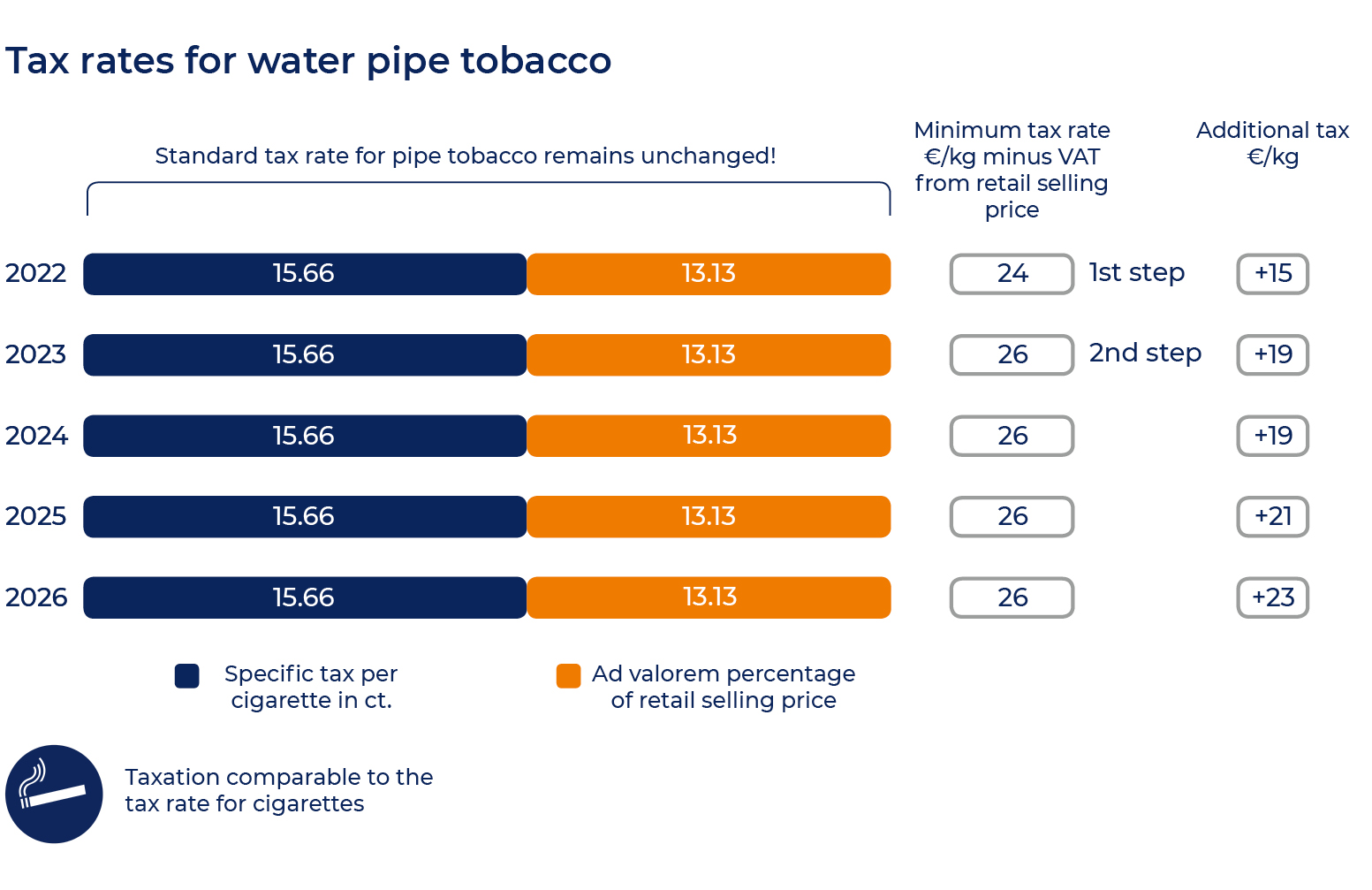
- Water pipe tobacco will be taxed at the same rate as the tax for cigarettes from 1 January 2022.
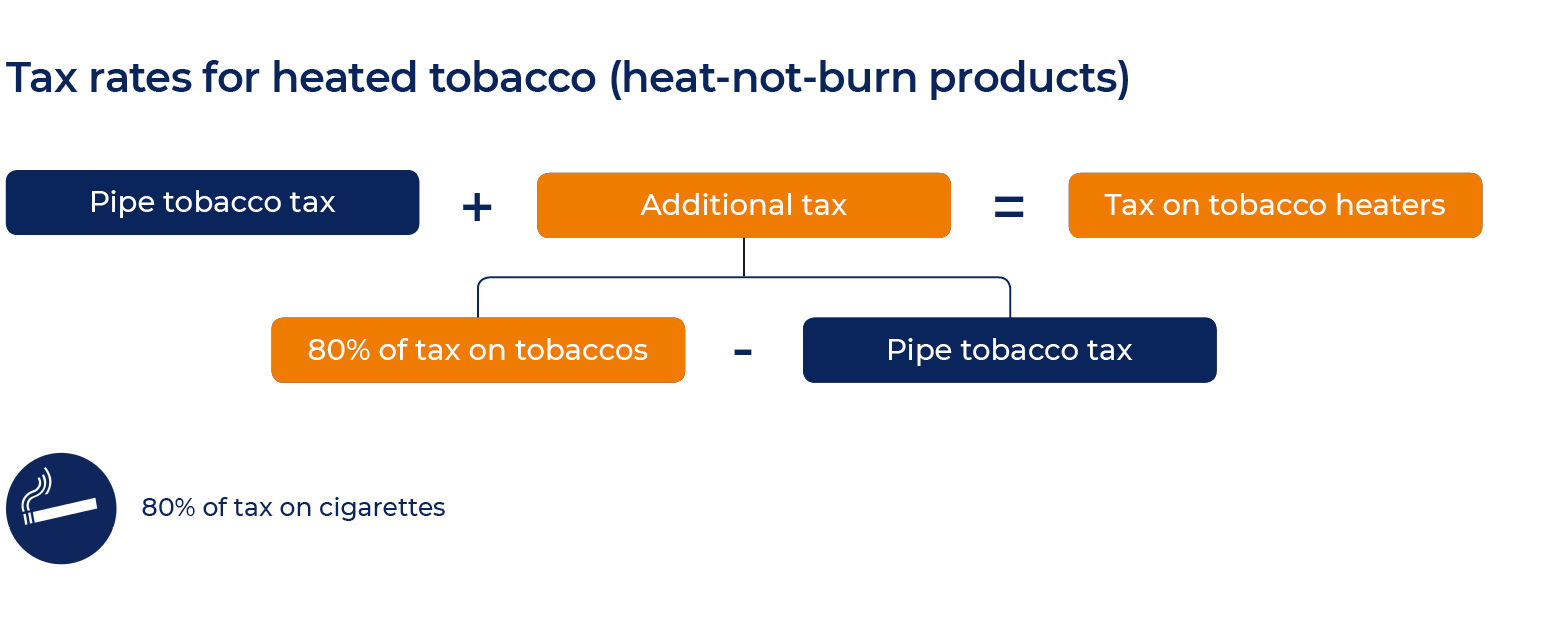
- For tobacco heaters, a supplementary tax will be introduced from 1 January 2022, so that the tax on these products will be 80% of the tax burden on cigarettes. .
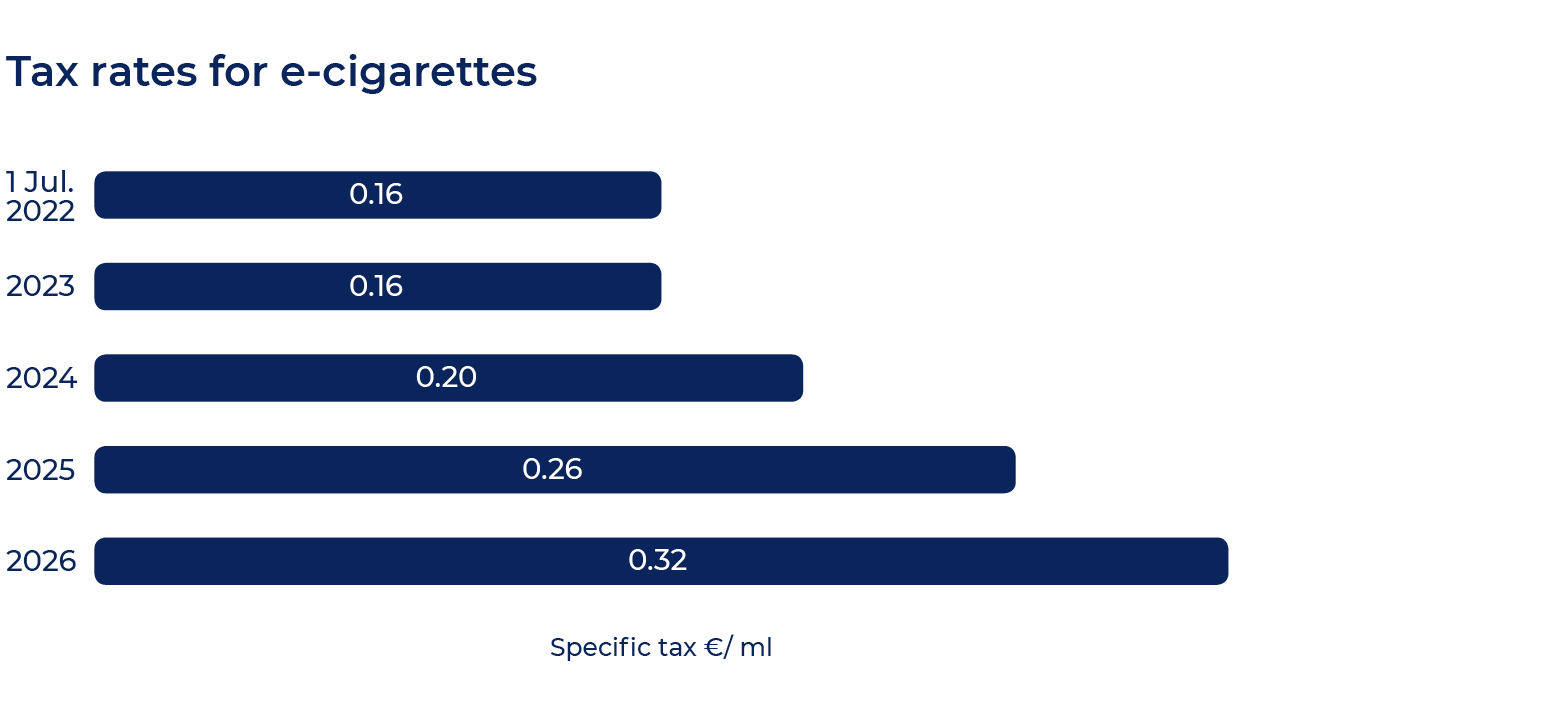
- Substances for the use in e-cigarettes such as liquids (so-called substitutes for tobacco products) will be subject to tobacco tax in future from 1 July 2022. Until now, only turnover tax had to be paid. All consumables intended for vaping will be taxed: Bases (propylene glycol, glycerine), nicotine and flavourings.
- A differentiated taxation of novel products (e-cigarettes, tobacco heaters) with regard to harm reduction was not considered. These products are subject to a relatively high tax burden.
-
Contrary to previous regulations on moderate increases in tobacco duty, the Bundestag passed a resolution in October 2026 to increase tobacco duty, which will come into force as early as 1 January 2027. Further details will follow. During the extremely brief legislative process, the BVTE had campaigned for a more realistic fiscal policy through its “Tobacco Tax with a Sense of Proportion” campaign and, together with third parties, had drawn attention to the problems posed by an excessive tobacco tax. Further details can also be found under
 Press.

Which products are taxed?
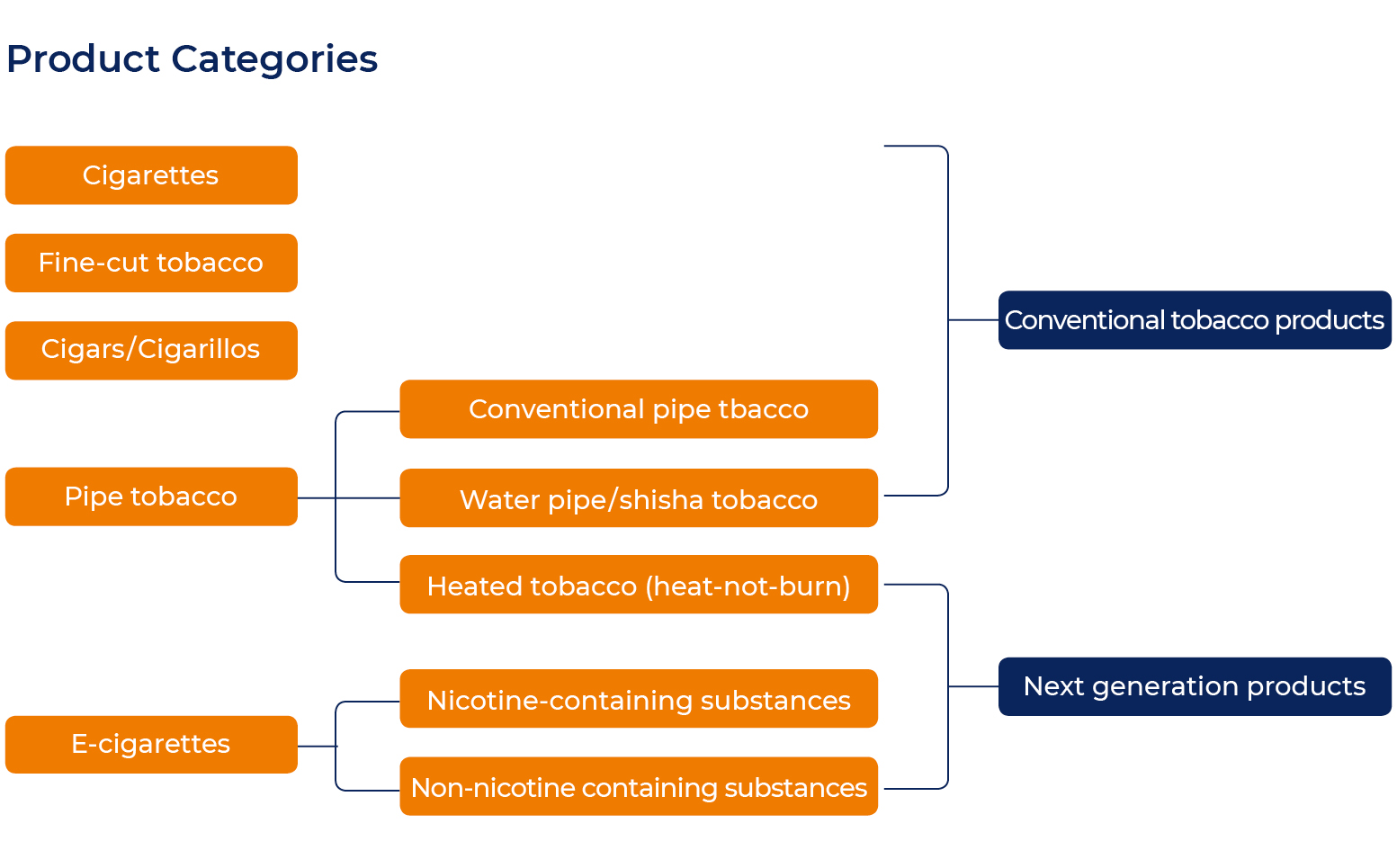
Tobacco tax is levied on the following products with different tobacco tax rates:
- Cigarettes
- Cigars and cigarillos
- Fine cut
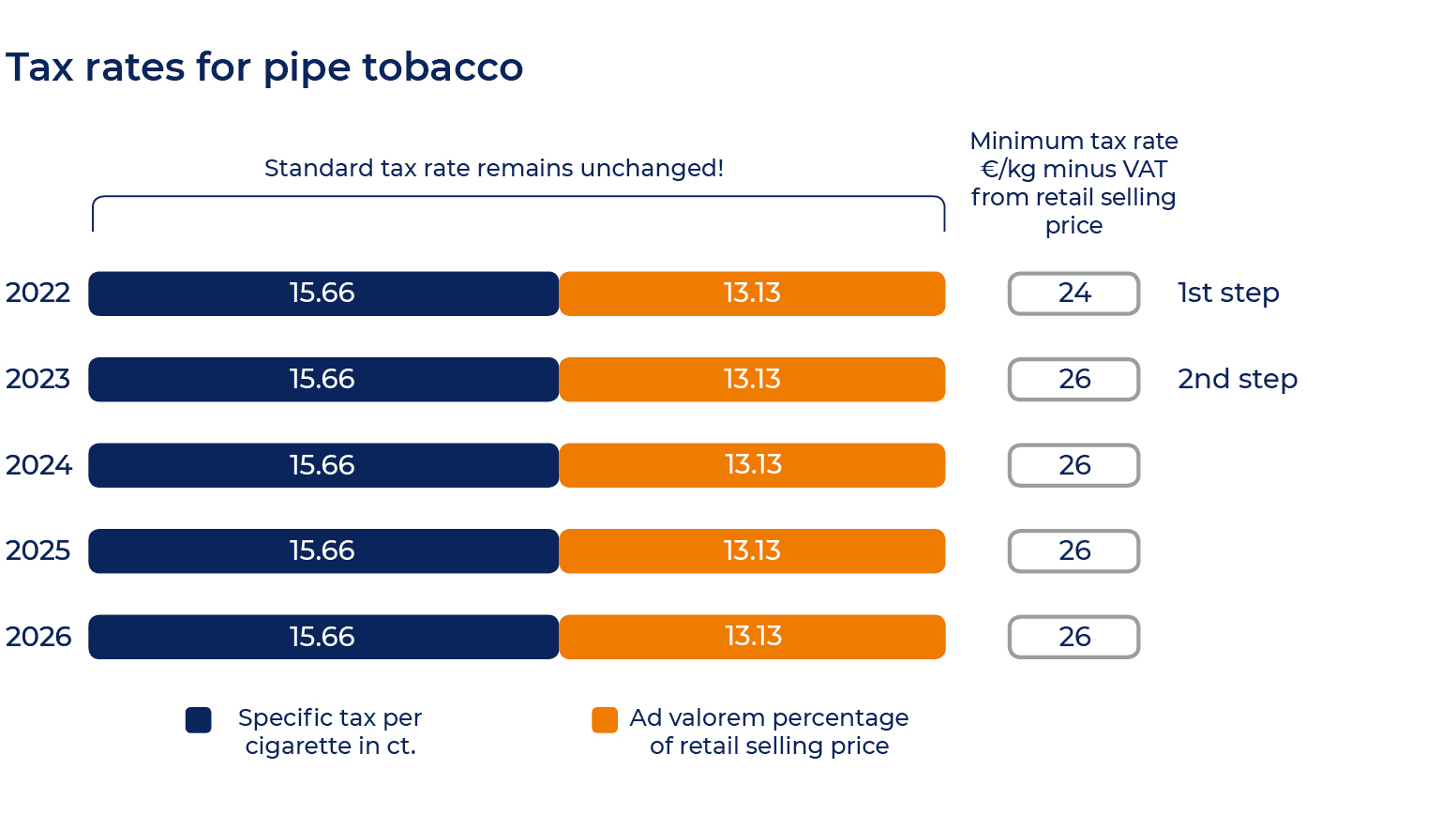
- Pipe tobacco
These include classic pipe tobacco, water pipe tobacco and tobacco heaters - also called heat not burn products.
No tobacco tax is yet levied on small niche products such as snuff or chewing tobacco. E-cigarettes are also not subject to tobacco tax in Germany so far. This will change for e-cigarettes on 01.07.2022.
Substances, e.g. liquids, for use in e-cigarettes (so-called substitutes for tobacco products) will in future be subject to tobacco tax from 1 July 2022. Until now, only turnover tax had to be paid. All consumables intended for vaping will be taxed: Bases (propylene glycol, glycerine), nicotine, flavouring substances

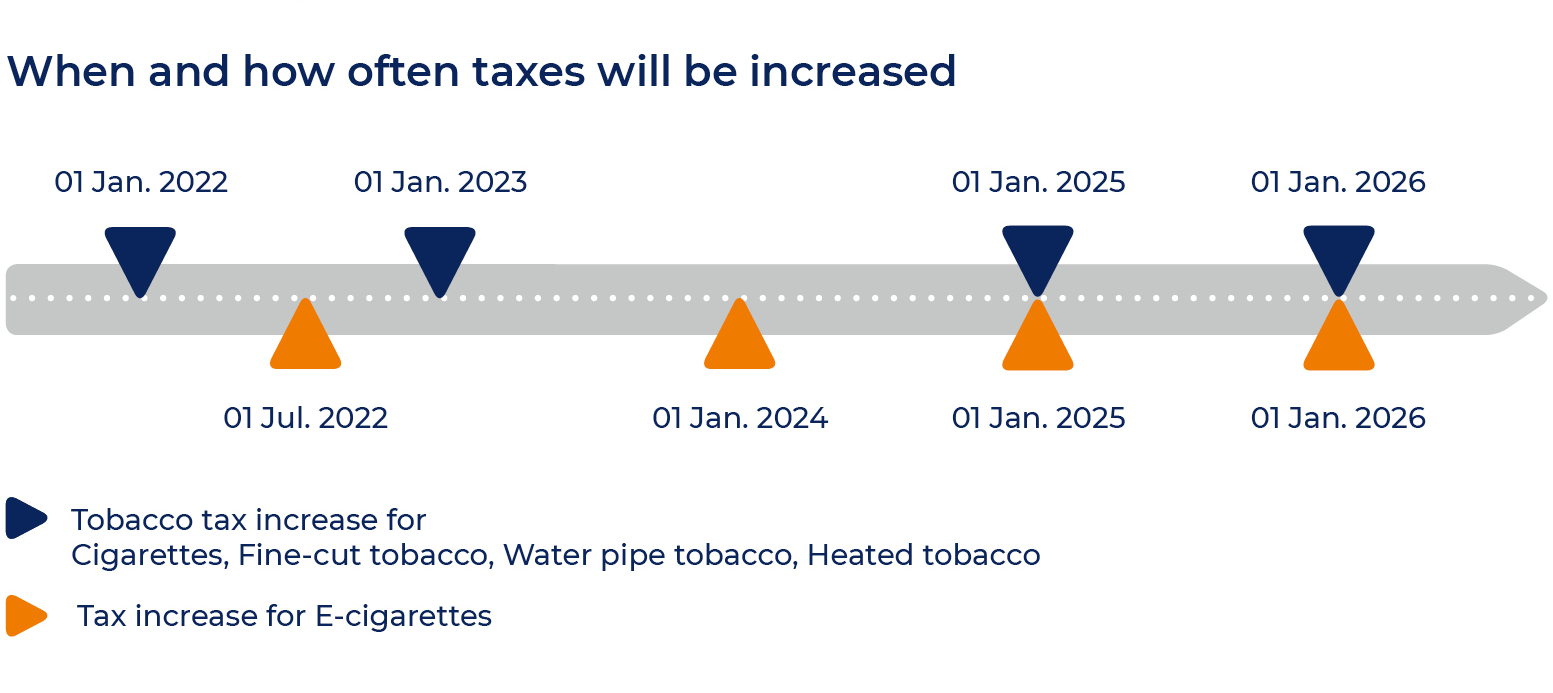
When and how often taxes will be increased?
The tobacco duty on most product categories was increased in four stages over a five-year period from 2022 to 2026. E-cigarettes were subject to tobacco duty for the first time from 1 July 2022.

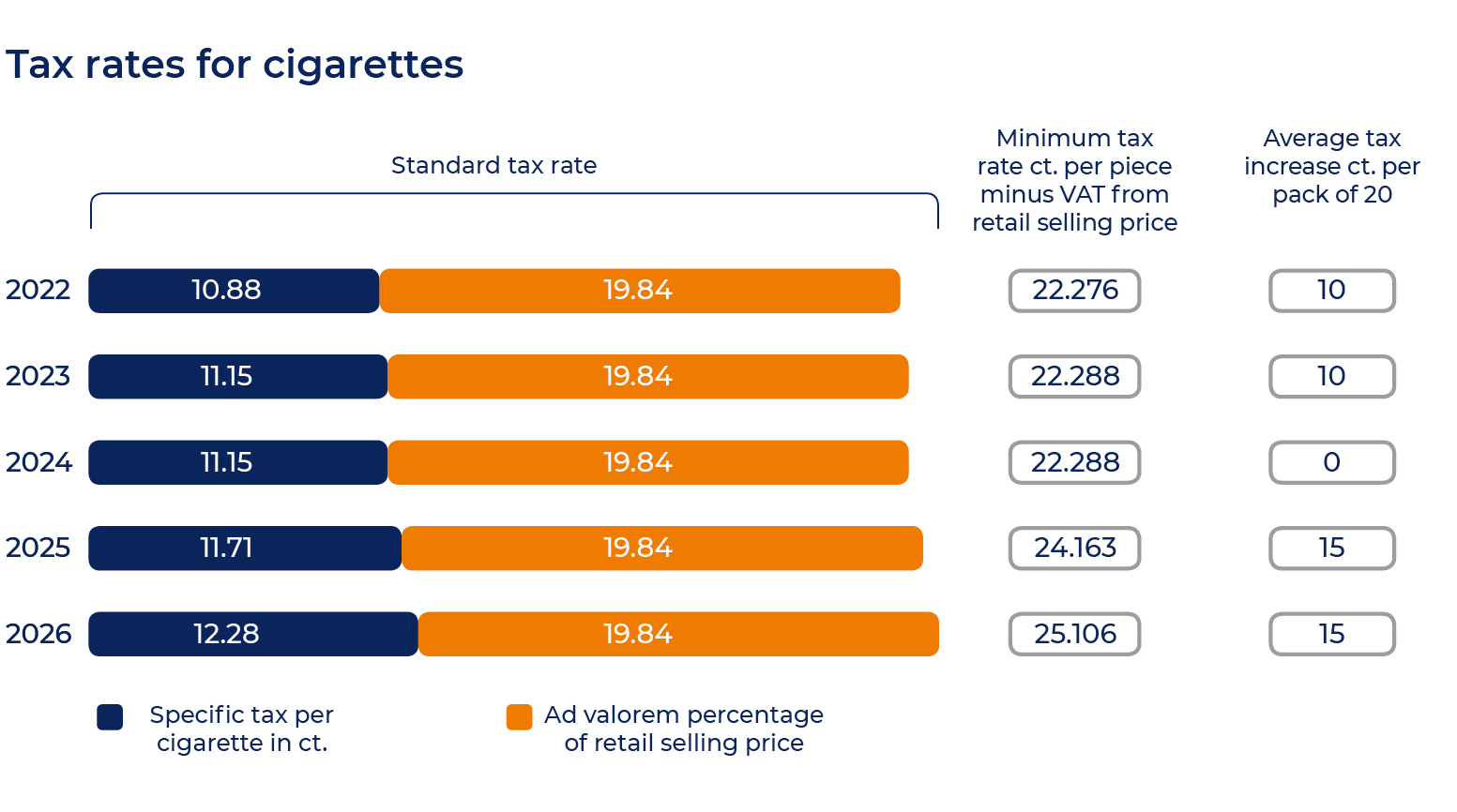
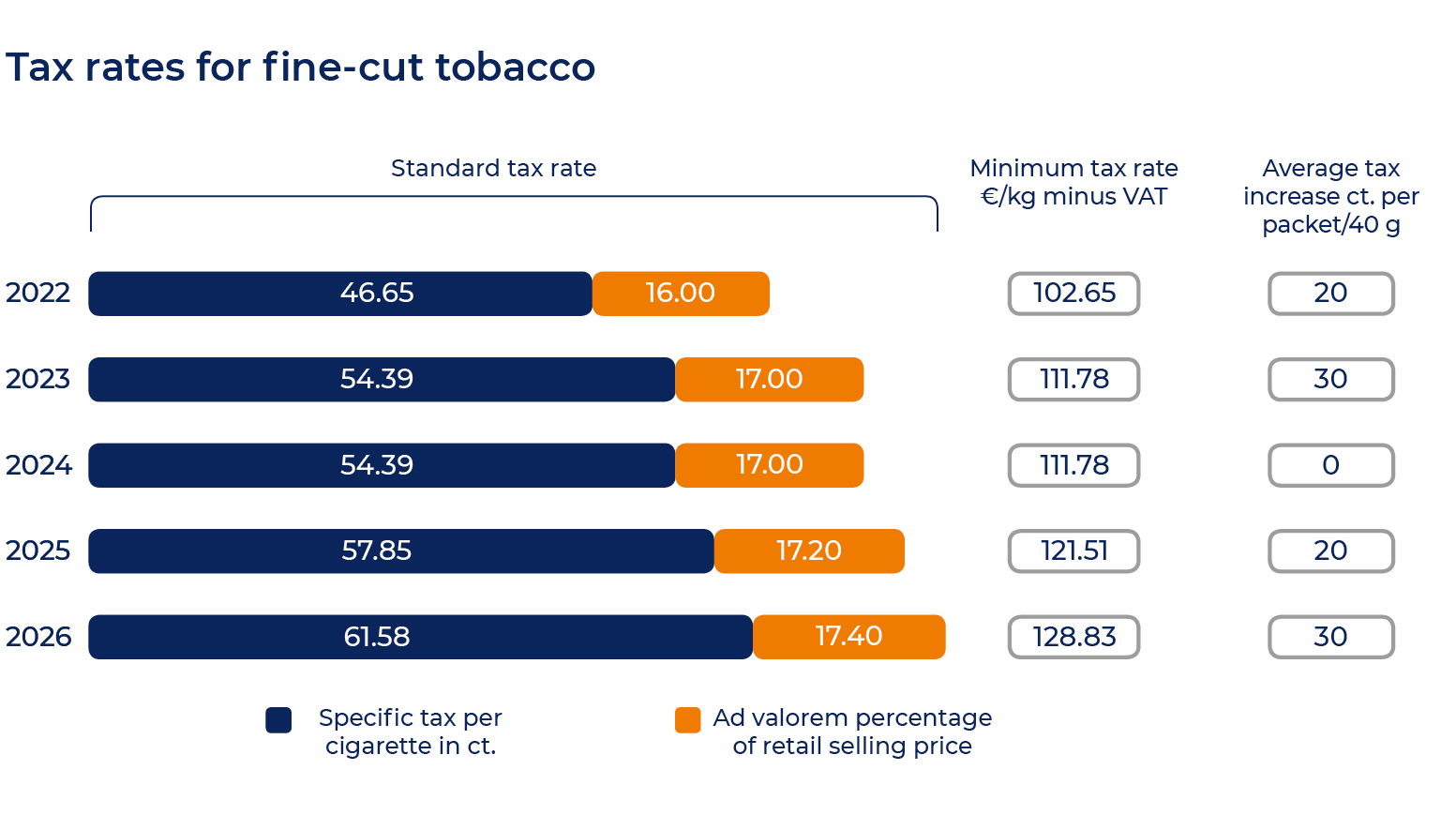
Which products are taxed and how?
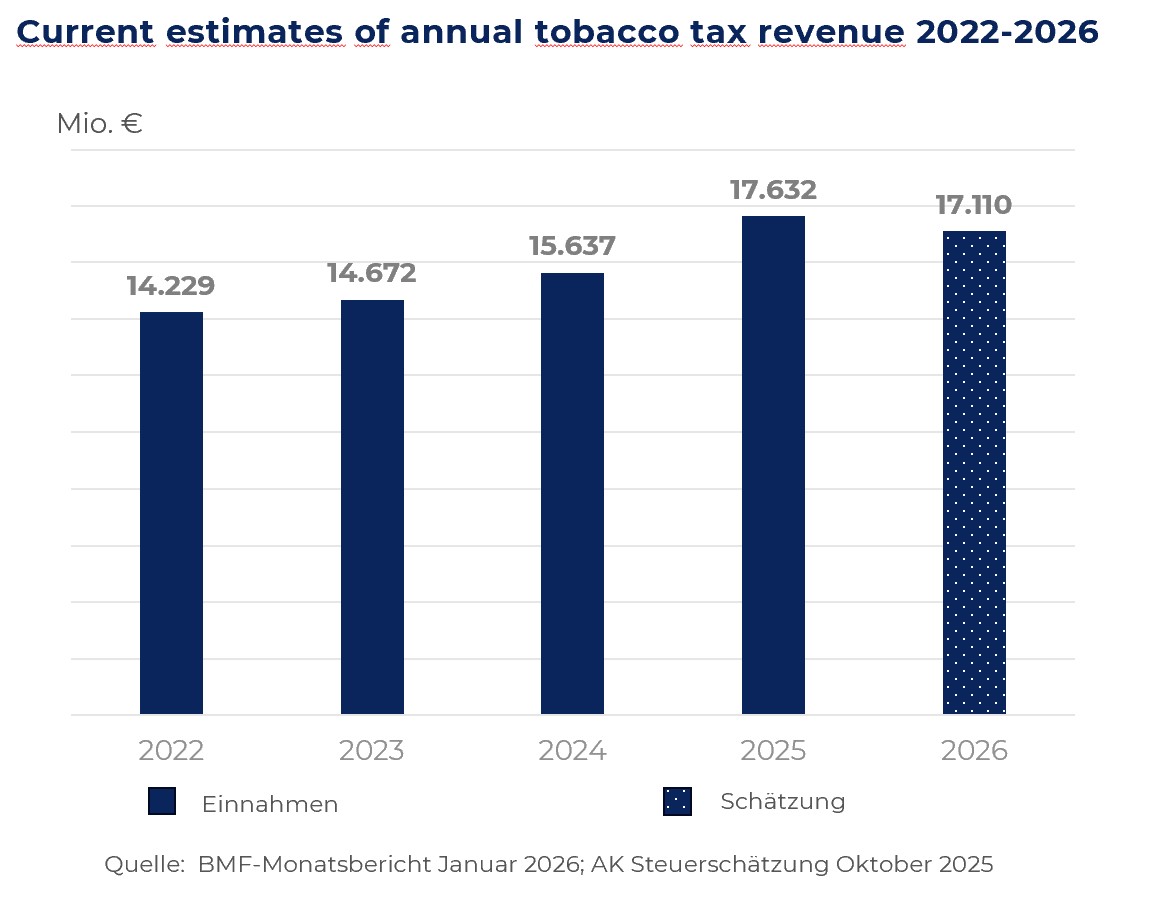
Current estimates of annual tobacco tax revenue 2022-2026.
Cigarettes
Fine-cut tobacco
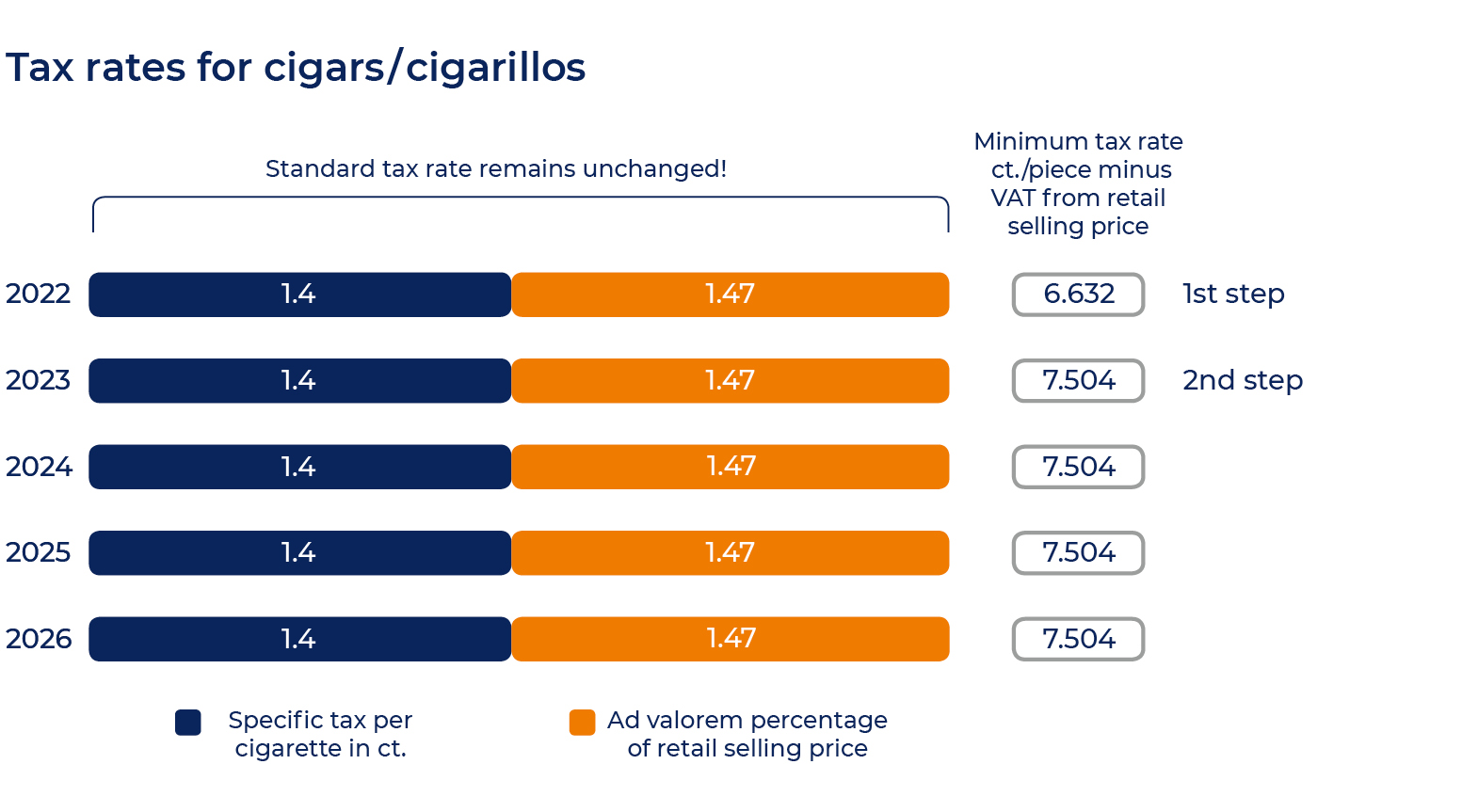
Cigars and Cigarillos
Pipe tobacco
Water pipe tobacco
is subject to the tax rate for pipe tobacco, but is subject to additional taxation. This additional taxation is intended to protect young people and health. Products that do not contain tobacco, e.g. steam stones, smoke pastes, are also considered water pipe tobacco. According to the customs administration, the additional tax rate also applies to these substitute products.
Heat-not-Burn-products
Heated tobacco is subject to the tax rate for pipe tobacco, but is subject to additional taxation. The additional tax is 80% of the cigarette tax minus the pipe tobacco tax. In the draft law for the increase, this is justified by the fact that these products are consumed in the context of existing nicotine addiction and substitute cigarettes.
E-Cigarettes
are also considered substitutes for tobacco products and are therefore subject to tobacco tax for the first time. Liquid substances with nicotine and without nicotine are taxed. Not only ready-mixed liquids but also basic substances such as bases like propylene glycol (PG), glycerine (VG) as well as flavours are subject to a fixed (specific) tax rate. What are taxable items or tobacco substitutes is also explained on the customs authorities’ website.

Current estimates of annual tobacco tax revenue 2022-2026
The Federal Ministry of Finance’s monthly report for July 2021 forecast a total of 14.5 billion euros in additional revenue resulting from the implementation of the Tobacco Tax Modernisation Act:
- Re-implementation of the tobacco tax model: a total of around € 10 billion
- Introduction of additional taxation on heated tobacco: a total of about € 1.5 billion
- Introduction of an additional tax on water pipe tobacco: in total about € 2 billion
- Introduction of taxation on substitutes for consumption in e-cigarettes: in total around € 1 billion
- The expected additional revenue for e-cigarettes was revised downwards by almost € 1 billion in the BMF monthly report. The amendment of the Finance Committee (document of the Bundestag no. 19/30490) still indicated an amount of € 1.947 billion. Since e-cigarettes will be taxed for the first time, it will be difficult to estimate the consumption behaviour and thus the tax revenue. Evasive reactions are to be expected.

Less red tape, more efficient administrative processes and better ways of combating the illicit tobacco trade
The BVTE and the German Cigarette Association (DZV) have been campaigning for a digital tax stamp for years. Existing digital infrastructures could form an important basis for this. The collection of tobacco duty in Germany is still based on physical tax stamps. These are produced as security documents by Bundesdruckerei GmbH on behalf of the customs administration, and are managed and issued via the Bielefeld Main Customs Office. Their procurement is directly linked to the tax return. On the packaging, they serve as visible proof of tax payment, protection against counterfeiting and tamper-evident seals.
High administrative and logistical costs due to physical tax stamps
Physical tax stamps must be ordered, produced, transported, insured, stored, inventoried and managed. Added to this are order deadlines, demand notifications, stock checks and procedures for the return or destruction of unused tax stamps.
Manufacturers must forecast their requirements well in advance and hold stocks of tax stamps, even though future production and sales volumes are often not yet known. Tariff and price changes, in particular, require forward-looking planning and stockpiling. In some cases, dedicated external warehouses are operated for this purpose under tax supervision. The consequences are additional costs, tied-up capital and limited flexibility – burdens that can particularly affect small and medium-sized enterprises.
Digital tax stamps create opportunities for business and customs
A digitally supported tax stamp system could record tax-relevant information electronically and link tax returns, tax verification and monitoring more closely. One possible approach would be to link this to a unique product identifier on each package, through which relevant data could be stored digitally and verified by the relevant authorities.
This could reduce physical processes and data disconnects, as well as lower transport, storage, insurance and administrative costs. It could also minimise risks arising from the loss or theft of physical tax stamps and reduce the effort involved in their return and destruction.
For customs authorities, digital access to tax-relevant information could facilitate the verification of correct taxation, make irregularities more readily detectable and enable more targeted checks. In conjunction with suitable verification mechanisms, this could also support the fight against the illicit tobacco trade.
Making effective use of existing digital infrastructure
The European Track and Trace system for tobacco products already provides a digital infrastructure that utilises individual product identifiers and documents the movement of goods. Bundesdruckerei GmbH, as the German ID issuer, is involved in this system and has experience with secure identification and labelling solutions.
It should therefore be examined how this infrastructure can also be utilised for tax purposes. Linking existing identification and traceability functions with tax-relevant information could avoid duplication of structures and make more efficient use of existing technical solutions. This requires a legally compliant and technically suitable design that meets the requirements of tax administration and product control.
A concrete approach to reducing bureaucracy and modernising the state
The modernisation of the tax stamp exemplifies the task of adapting administrative procedures, which have evolved over time, to the possibilities offered by digitalisation. The aim should be fully electronic tax processing with digital interfaces between businesses and the customs administration, ensuring reliable tax control whilst avoiding unnecessary administrative and logistical burdens.
A digital tax stamp offers the opportunity to utilise existing technical capabilities for modern tax administration, to relieve businesses and authorities of avoidable burdens, and to improve the monitoring of the tobacco market.