
Risk Reduction

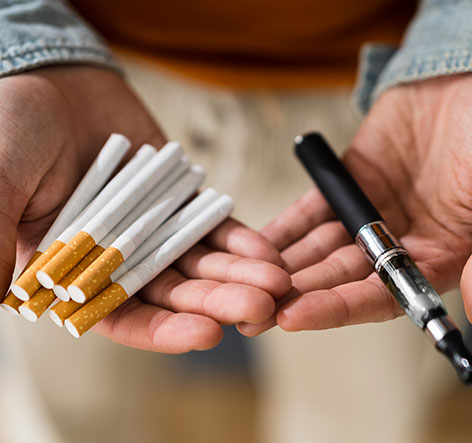


Risk Reduction - Tobacco Harm Reduction
The Tobacco Harm Reduction approach is about the potential reduction of health risks of tobacco use by providing potentially less harmful products.
The concept of risk or harm reduction was described in 2001 in the report of the American Institute of Medicine Clearing the Smoke. The experts came to the conclusion that the health risks of tobacco consumption can be reduced not only by stopping smoking. Risk-reduced products can also contribute to a significant reduction in health damage among smokers.
Tobacco smoke contains up to 7,000 different substances in addition to nicotine, most of which are produced by pyrolysis and combustion processes and of which more than two hundred are associated with secondary smoking diseases. About a hundred are classified as causes or possible causes of cancer.
While nicotine poses health risks and is addictive, it is neither carcinogenic nor a major cause of smoking-related disease. However, due to the close association of nicotine with tobacco and smoking, there are many misconceptions about the risk potential of nicotine.
Detailed information on the entire complex of topics can be found  HERE.
HERE.
Nicotine pouches are potentially a less harmful alternative to tobacco use – but they are not yet available over the counter in Germany
Nicotine pouches are a tobacco-free alternative to conventional cigarettes and tobacco products. They consist of porous sachets that contain starch, plant fibres, flavourings and purified nicotine. Pouches are placed in the mouth under the upper lips for use. The nicotine is absorbed through the oral mucosa. Similar to chewing tobacco and other smokeless tobacco products, no carcinogenic or harmful combustion products occur. Pouches are available in many member states of the European Union in stores or via the Internet. Due to an official classification as ‘novel food’, pouches are currently not allowed to be sold in Germany.
The BVTE has a clear position on this: nicotine pouches are not consumed, but used to enjoy nicotine. Therefore, the health assessment cannot be based on the standards of unintentional nicotine intake, which can occur, for example, through certain foods (BfR, 2009). Users do not have a corresponding need for protection against nicotine and the transfer of food law principles leads to a misleading reversal of the actual intention: to enjoy nicotine for relaxation or as a stimulant. Therefore, similar assessment criteria should apply to pouches as to e-cigarettes and tobacco products that are also used to enjoy nicotine. However, these products and product categories pose very different health risks, which must be characterised by an appropriate assessment. The German Federal Institute for Risk Assessment (BfR) and the Dutch health authorities (RIVM) agreed in their fundamental assessments in 2021 that nicotine pouches are potentially significantly less harmful than conventional cigarettes. Both institutions recommended that pouches be regulated under tobacco law (BfR, 2021a; RIVM 2021).
Nicotine pouches pose comparatively low health risks compared to other tobacco and nicotine products. The BfR published its own studies on the levels of harmful substances (Mallock et al., 2024). In addition to nicotine, the carcinogenic tobacco-specific nitrosamines (TSNA) were also determined, but only traces were detected. The BVTE assessed the potential cancer risks based on the analytical data from the BfR for 44 products (Mallock et al., 2024) according to the criteria of the California Office for Environmental and Health Hazards Assessement (OEHHA)1. TSNA were detected in a total of 26 pouches. However, due to the low levels, health impairments are very unlikely. With a daily consumption of eight pouches, the cancer risks for 43 products would still be below the significance threshold set by OEHHA of potentially one additional disease per 100,000 users. Furthermore, smokeless nicotine consumption avoids combustion products (nitrogen oxides, acrolein and other carbonyl compounds, carbon monoxide, etc.) that damage the cardiovascular system. Increased risks of respiratory diseases can also be ruled out. The comparatively low risks of oral nicotine consumption are also evident from the example of Sweden (Fagerström, 2023). There, a smokeless tobacco product displaced the cigarette, which is used orally in a similar way to nicotine pouches. With the growing dominance of Swedish snus, there was a significant decline in smoking-related illnesses among men, although the proportion of nicotine users hardly changed.
The BfR illustrated these relationships in its statement 042/2021 of 21 December 2021 by classifying pouches at the lowest end of the harm continuum (BfR, 2021b, BfR, 2022) of tobacco and nicotine products according to Abrams et al. (2018). Nicotine pouches can therefore be considered the least harmful option for nicotine consumption. The toxicological risks are comparably low, as they are for pharmaceutical nicotine replacement products.
Concerns about nicotine pouches are also justified by the high nicotine levels. However, studies of commercially available products (<12 mg per pouch) have found lower blood nicotine levels than with smoking (Lunell et al., 2020). However, there was a data gap for products with higher doses. In 2024, the BfR presented a study on this topic in which doses of 6, 20 and 30 mg nicotine per pouch were examined (Mallock-Ohnesorg et al., 2024). Only the highest dosage (30 mg) produced higher blood nicotine levels than smoking. The maximum level of 16.7 mg nicotine per g pouch originally proposed by the BfR would therefore also be a good orientation for future regulation from a pharmacokinetic point of view.
Although the data situation for nicotine pouches illustrates great potential in terms of tobacco harm reduction, there has been little progress at the regulatory level. In a recent press release, the BVTE complained that nicotine pouches are still available in Germany despite being banned from about 1300 mostly foreign sources. According to the figures of the DAK Prevention Radar, 15% of 16- and 17-year-old male adolescents have tried nicotine pouches (see BVTE press release dated 20 December 2024, ). Little is known about the quality of black and grey market products. The BVTE considers a timely specific legal regulation to be urgently needed in the interest of legal certainty, consumer protection and a uniform approach throughout Germany. Similar to e-cigarettes, the manufacture, packaging and sale of pouches should be generally permitted and regulated on a product-specific basis.

Links
Are e-cigarettes just as harmful as tobacco cigarettes?
In a press release, the German Society for Pneumology and Respiratory Medicine (DGP) stated that e-cigarettes are “roughly as dangerous as tobacco cigarettes”. It was also claimed that the simultaneous use of e-cigarettes and tobacco cigarettes (“dual use”) could be even more harmful to health than smoking tobacco cigarettes alone.
The press release does not cite any specific scientific source for these statements. However, in terms of content, the statements largely correspond to the conclusions of a study by Glantz, Nguyen and Oliveira da Silva published in 2024 in NEJM Evidence.
What did the study by Glantz et al. investigate?
The study analysed data from a large US population survey. Non-smokers, smokers, exclusive e-cigarette users and so-called dual users were compared with regard to various diseases.
The authors reported that e-cigarette users were more likely to have certain health conditions than non-smokers, and that some of the measured risk levels were of a similar magnitude to those seen in smokers. From this, they concluded that e-cigarettes could be similarly harmful to tobacco cigarettes.
Why is the study being criticised?
The study’s conclusions met with significant international criticism from scientists in the fields of epidemiology, addiction research and tobacco control. Critics include, among others, Michael Siegel (Boston University), Konstantinos Farsalinos, Peter Hajek (Queen Mary University of London), Jamie Hartmann-Boyce, Colin Mendelsohn and Brad Rodu.
The criticism is directed primarily at the study’s methodology:
1. No conclusions regarding cause and effect
The study is based on a one-off population survey (cross-sectional data). Such data can describe correlations but do not allow for reliable conclusions as to whether a disease was actually caused by the use of e-cigarettes.
2. Previous smoking history is not adequately taken into account
The majority of e-cigarette users surveyed were current or former smokers. Many illnesses could therefore be attributed to long-term tobacco use rather than to subsequent e-cigarette use.
3. Illnesses often existed before the switch
The study does not adequately consider whether illnesses were already present before the switch to e-cigarettes. As a result, health problems may be incorrectly attributed to e-cigarettes.
4. The problem of ‘reverse causation’
A well-known methodological problem in tobacco research is so-called ‘reverse causation’. Many smokers switch to e-cigarettes due to existing health problems. In surveys, they then appear as e-cigarette users, even though their health conditions developed during the time they were smokers.
Several reanalyses and expert commentaries therefore conclude that the data do not allow for a reliable conclusion that e-cigarettes are as harmful as tobacco cigarettes.
What does the rest of the scientific evidence say?
The claim that e-cigarettes are just as harmful as tobacco cigarettes is not supported by a large part of the scientific literature.
Numerous reviews and risk assessments conclude that, whilst e-cigarettes are not risk-free, they significantly reduce exposure to toxic and carcinogenic substances compared to smoking.
International health authorities also assess the risks differently:
In their evidence reports, British health authorities conclude that e-cigarettes are significantly less harmful than tobacco cigarettes.
The US Food and Drug Administration (FDA) found, as part of several authorisation procedures, that the aerosols from authorised e-cigarettes contain significantly lower levels of harmful and potentially carcinogenic substances than cigarette smoke.
The FDA also emphasises that adult smokers can benefit health-wise from switching completely to suitable e-cigarettes.
What is the evidence regarding cardiovascular diseases?
Current research on cardiovascular diseases also does not support equating e-cigarettes with tobacco cigarettes.
Although studies show that e-cigarettes have biological effects on the cardiovascular system and cannot be considered risk-free. However, several recent reviews, meta-analyses and longitudinal studies predominantly arrive at the following conclusions:
The highest risks are observed among smokers and dual users.
For exclusive e-cigarette users, the available data so far show no or only a small statistically significant increase in risk of heart attack, stroke or other cardiovascular diseases.
Long-term data remain limited, which is why further prospective studies are necessary.
The current evidence therefore does not provide a reliable basis for the claim that the cardiovascular risks of e-cigarettes are equivalent to those of tobacco cigarettes.
Conclusion
E-cigarettes are not risk-free and should not be used, particularly by young people. However, the claim that e-cigarettes are ‘roughly as dangerous as tobacco cigarettes’ is not supported by the body of available scientific evidence, nor by the assessments of leading health authorities.
The equivalence claimed by the DGP is based largely on a study whose methodology and conclusions have been widely criticised by experts in the field. Proper risk communication should acknowledge the existing uncertainties, whilst also taking into account the significant differences between combustion products such as tobacco cigarettes and non-combustible nicotine products.
Conventional and novel tobacco and nicotine products pose different levels of risk to human health. Tobacco heaters and e-cigarettes avoid combustion processes so that fewer pollutants are released overall and the levels are significantly lower than in cigarette smoke. Consumers and bystanders are exposed to significantly fewer harmful substances, potentially reducing health risks. Properly manufactured oral nicotine products are the least harmful option for nicotine consumption and pose no risk to bystanders.
Every adult smoker has a unique relationship with smoking and there are a variety of reasons why people smoke tobacco. For many smokers who want to reduce their health risks, complete abstinence is not a realistic alternative. Novel products may provide a suitable alternative for adult smokers who continue to use nicotine but want to abstain from smoking tobacco products.
To be an acceptable alternative for adult smokers, novel products offer satisfying nicotine enjoyment because they can simultaneously serve sensory, social and behavioural aspects of smoking as a ritual - unlike medical nicotine replacement products (e.g. nicotine patches or gum).
Risk reduction through Tobacco Harm Reduction should first be considered as an individual option to avoid secondary smoking diseases. At the same time, the level of the entire population (public health aspect) must also be taken into account. Novel products must therefore fulfil three key criteria in the context of potential risk reduction:
- They must produce significantly fewer or lower amounts of harmful substances.
- They must be a satisfactory substitute for adult smokers.
- They must be unattractive to non-smokers as well as children and adolescents in order to avoid possible gateway effects, i.e. the initiation of later smoking. This requires both appropriate regulation and responsible distribution, especially not aimed at children and adolescents.
An dieser Stelle verlinken wir eigene Artikel und Beiträge und empfehlen interessante Literatur zum Thema:
- Gastartikel zu Tobacco Harm Reduction von Dr. Frank Henkler-Stephani, BVTE, in Heino Stöver (Hrsg.) Tobacco Harm Reduction, Fachschulverlag Frankfurt/M. S. 89-114, ISBN ist 978-3-947273-52-2 PDF Gastartikel Dr. Frank Henkler-Stephani, BVTE
- Karl Olof Fagerström, 2021, Harm Reduction in Sweden – the case of snus in Tobacco Harm Reduction, Fachschulverlag Frankfurt/M. S. 197-206, ISBN 978-3-947273-52-2 PDF Karl Olof Fagerström englisch | PDF Karl Olof Fagerström deutsch

The basis for regulation of novel tobacco and nicotine products should be a robust and comprehensive scientific assessment. Data should demonstrate that a product is significantly less harmful than conventional tobacco products.