Littering


Waste in the environment is a global problem. Littering is often caused by thoughtlessness and a lack of responsibility or due to missing disposal options. In addition to fast food packaging, chewing gum and bulky waste, cigarette waste also pollutes the environment in many places, as not all smokers dispose of their cigarette waste properly in rubbish bins when outside.. Many smokers are not even aware that they are polluting the environment and committing an offence.
Single-Use Plastic Fund
In order to curb environmental pollution caused by single-use plastics, a European strategy for reducing plastic waste was developed at EU level in 2018 and laid down in the EU Directive on reducing environmental pollution caused by single-use plastics.
The legal basis for this in Germany was established through corresponding provisions in the Closed Substance Cycle Waste Management Act ( KrWG) and announced in the Federal Law Gazette on 15 May 2023 in the so-called Single-Use Plastics Fund Act ( EWKFondsG).
Since then, manufacturers of single-use plastic products, including cigarette filters, have taken on more responsibility for all waste disposed of in public spaces. Politically, the problem of littering was thus to be solved by imposing a unilateral legal obligation on manufacturers and releasing consumers from their duty to dispose of waste correctly.
Manufacturers of cigarette filters are to bear a proportionate share of the costs of waste disposal and street cleaning for all cigarette butts disposed of in public spaces. The tobacco industry bears the ‘lion's share’ of this cost, contributing more than €160 million annually to public cleaning costs in Germany in the first year.
The results of the fund's first year are sobering. Based on the reported product quantities, it can be deduced that only around €248 million was collected in the first year of the EWK fund for 2024 – instead of the predicted €436 million. In addition, the disbursement of the fund's resources is delayed by one year because only a few municipalities registered with the fund in 2025 and were able to report their cleaning services.
The current status of the EWK fund continues to cast a critical light on the data basis and the structure of the fund: Are the basic assumptions about product quantities and manufacturer numbers realistic?
When the EWK levy was set, the number of manufacturers subject to the levy assumed by the Federal Environment Agency (UBA) was already very high and, in the view of the manufacturers' associations, subject to considerable uncertainty. In retrospect, some of the forecast product quantities also appear to have been set too high. At the same time, all calculations are based predominantly on data from 2020 and do not adequately reflect current market changes, substitutions and innovations.
Too little clarity in the classification of products as subject to the to-go levy?
In recent years, many manufacturers have applied to the UBA for classification of their products. The key question is: ‘Is my product a to-go product and do I have to pay the EWK levy?’ Many of these applications are still pending, and in some cases the UBA is taking a disproportionately long time to reach a decision. However, it appears that the UBA is using its scope for interpretation and classifying a large number of supermarket products as subject to the levy. A particularly well-known example is the classification of a 750-gram Christmas stollen as a litter-prone to-go product – which has since been withdrawn due to a wave of protests from the baking industry. Manufacturers have lodged appeals against some of the UBA's decisions, but overall the situation is causing considerable uncertainty in the industry.
Are there many free riders – i.e. unregistered manufacturers?
The figures from the EWK fund on the DIVID platform are based on information provided by participating companies that comply with the rules. Free riders – i.e. unregistered manufacturers and product quantities – lead to distortions of competition. The number of free riders is unknown. The UBA has only limited resources for verification and control and relies largely on market participant control. At the same time, the DIVID system itself has so far offered few practical options for research and verification.
Is the bureaucratic effort too high for small manufacturers?
For many smaller manufacturers, the system as a whole proves to be too bureaucratic and financially burdensome, e.g. due to the mandatory verification of their reports by an auditor even for small market quantities of 100 kg per year. In individual cases, this can lead to additional verification costs that are higher than the EWK levy. How representative is the data basis for the EWK levy overall?
The considerable deviations in the reported product quantities compared to the forecast raise fundamental doubts about the data basis used to calculate the EWK levy.
There is no nationally representative data basis for the cleaning costs of the municipalities used as a basis. Municipalities record and account for cleaning and disposal costs and waste quantities in very different ways. This is also evident from the fact that very few municipalities have so far been able to register on the DIVID platform and report their cleaning services.
The waste analyses used are based predominantly on surveys in large cities, while rural municipalities and smaller towns have hardly been taken into account. At the same time, an attempt was made to reflect increased cleaning costs using waste item counts, although there is neither a uniform methodology nor consistent data for this.
Should the contribution to cleaning costs be organised differently?
The manufacturers had originally proposed organising the cost sharing themselves in a lean structure under the umbrella of the ZSVR – thus implementing the so-called manufacturer responsibility literally. However, the legislator opted for an organisation via the Federal Environment Agency and set up a separate task force for this purpose – with limited resources. At the same time, the implementation also raises questions of financial constitutional law, which are currently being examined for legality by the Federal Constitutional Court.
The first EWK fund year thus clearly shows:
In its current form, the single-use plastics fund is overly complex, bureaucratic and based on insufficiently reliable assumptions. Manufacturers are therefore calling for a comprehensive review and simplification – in terms of the data basis, organisation and scope – to bring it into line with the real structures of the market and local authorities. Otherwise, there is a risk that the fund will neither be effective nor fulfil its actual purpose.
Criticism of cost allocation and legal proceedings
A levy does not protect our environment. Simply redistributing cleaning costs does not solve the problem of littering.
It should be noted that it is not manufacturers but consumers who carelessly throw away their waste. From the BVTE's point of view, the problem cannot be solved unilaterally, but only through the interaction of various actors and a wide range of measures, and only with a change in consumer behaviour. Most cigarette waste ends up in the environment mainly due to thoughtlessness. Raising consumer awareness of the need for greater mindfulness for a clean environment therefore remains a key focus of our association's work. More information on the BVTE environmental campaign
Since the beginning, the tobacco industry has been highly critical of the organisation of cost allocation and the calculation of costs. In May 2024, several companies had already filed constitutional complaints against the Single-Use Plastics Fund Act with the Federal Constitutional Court.
All BVTE members are expressly committed to their product responsibility and are already actively contributing to waste avoidance and the circular economy. In the interests of companies, the BVTE, together with other associations, has always campaigned for the most cost-efficient, transparent and unbureaucratic implementation of extended producer responsibility. The Single-Use Plastics Fund Act does not fulfil these requirements. In addition, there are considerable doubts about the compatibility of the law with the requirements of German financial constitutional law. All questions should be clarified by the Federal Constitutional Court.
Single-Use Plastics Commission
The Federal Environment Agency (UBA) has established the Single-Use Plastics Commission (EWK), which met for the first time in Berlin in September 2023. The commission advises the UBA and makes recommendations on the review and adjustment of levy rates in accordance with the regulation and on the design of new studies.
Six industry associations are represented on the EWK on behalf of the manufacturers, including the BVTE on behalf of the entire tobacco and nicotine industry. Other members of the EWK are: the municipal waste management industry (Verband kommunaler Unternehmen e.V. (VKU), Deutscher Städte- und Gemeindebund, Deutscher Städtetag, Allianz der öffentlichen Wasserwirtschaft e.V. (AöW), Deutscher Naturschutzring (DNR) e.V. and Verbraucherzentrale Nordrhein-Westfalen e.V. for the consumer protection associations. Further information on the EWK can be found HERE.
Studies on Littering
In the run-up to the implementation of the EU Directive, littering studies on the costs of collecting and disposing of single-use plastic items in public spaces were taken into account. The littering study presented in August 2021 by Federal Minister for the Environment Svenja Schulze (SPD) and VKU President and Lord Mayor Michael Ebling (SPD) was heavily criticised. For example, the German Cigarette Association, a member of the BVTE, criticised the study as incomprehensible. In the opinion of the cigarette manufacturers' association, the study was and is unsuitable for basing far-reaching political decisions on it. The detailed press release can be found HERE.
The engineering company pbo had determined in 2021 what quantities of cigarette waste were actually to be found in the various waste systems. According to the study, more than half of the cigarettes consumed in Germany were properly disposed of in household waste. In public waste, cigarette waste accounted for an average of 0.56% of the total quantity by weight. The study commissioned by the German Association of Local Public Utilities (VKU) determined a slightly higher proportion of around 1.3% of cigarette waste in public waste.
Both studies provided important base data for calculating the costs of future levies for manufacturers. While the results for the quantities of waste determined are still relatively close to each other, the situation is different when it comes to costs. According to the pbo study, even with very high estimated city cleaning costs of EUR 38.80 per capita per year, the maximum contribution of tobacco product manufacturers to city cleaning costs can be calculated at around EUR 24 million per year. In contrast, the VKU expects a disproportionately high annual cost sharing of 225 million euros. These very different results show that special emphasis must be placed on a transparent process with comprehensible for all parties involved when determining future costs.
You can find the pbo study HERE. A comparison of the two studies shows the differences HERE.
Filter
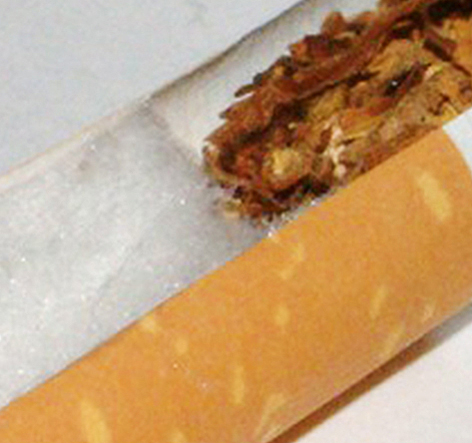
The filter is an important component of tobacco products. It filters out toxic substances from tobacco smoke and is needed to comply with the legally permitted maximum levels of tar, nicotine and carbon monoxide in smoke. The currently used filters are made of the bioplastic cellulose acetate. Although this material is completely biodegradable, it decomposes very slowly. Depending on the environmental conditions it takes between a few months and several years. For comparison: Petrochemically manufactured plastic products, such as plastic bottles, need up to 400 years to decompose.

Disposal of e-cigarettes and similar devices
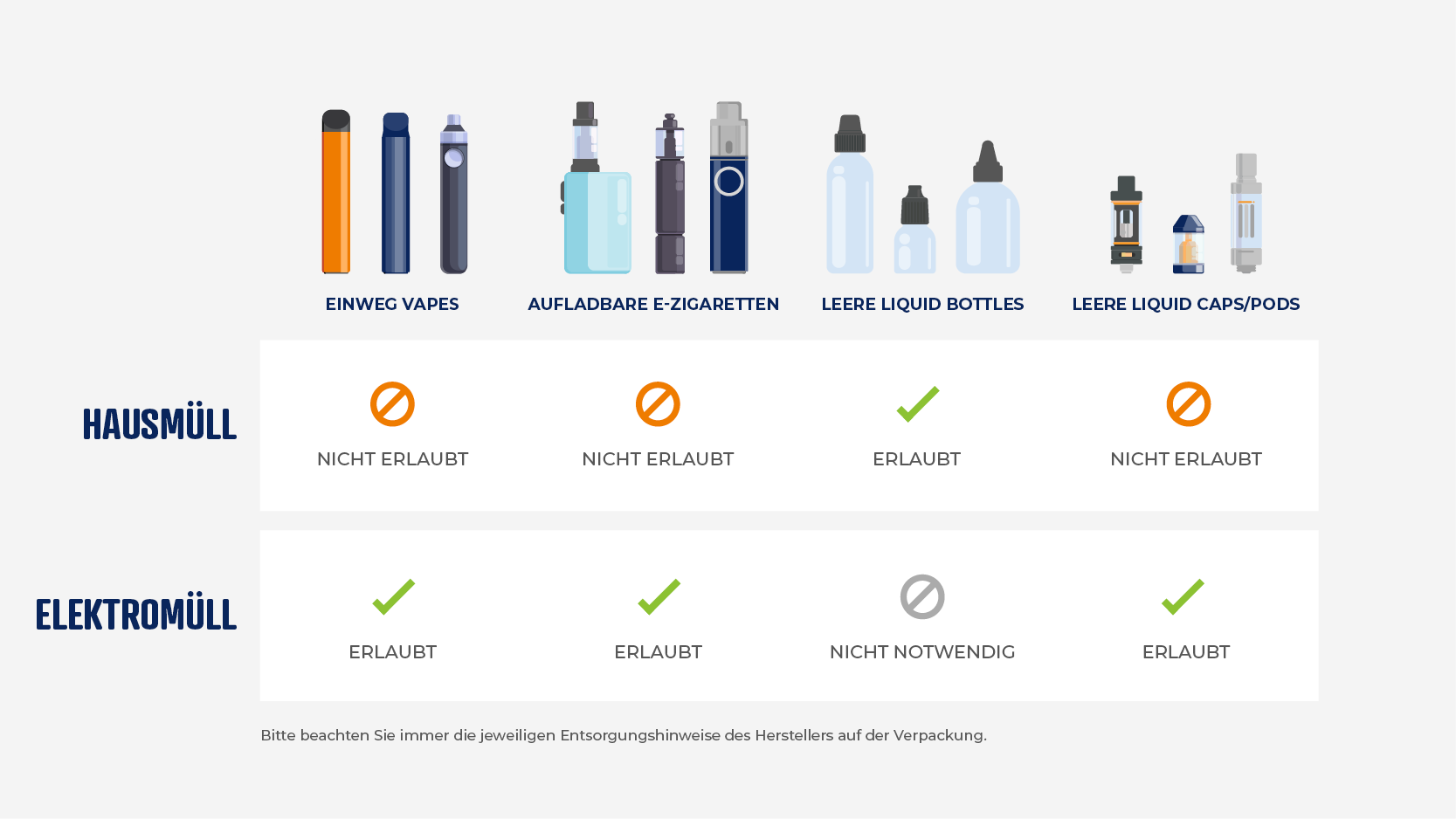
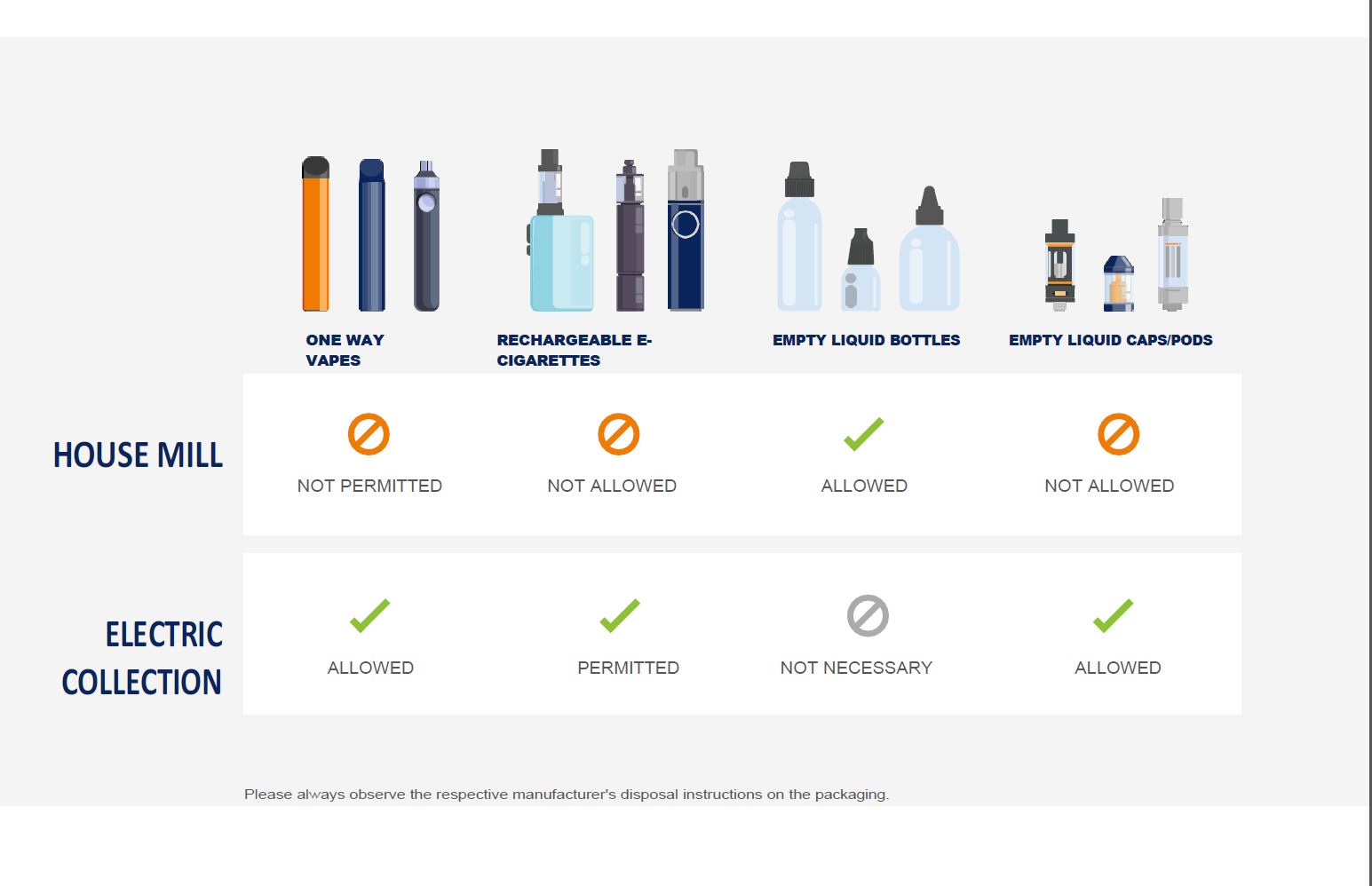
E-cigarettes and capsules/pods should not be disposed of in household waste; instead, they should be taken to a recycling centre as electronic waste, or returned directly to a specialist retailer or the manufacturer. As a rule, rechargeable batteries, batteries or other components containing harmful substances are labelled as such. The symbol of a crossed-out wheelie bin can be found on the devices themselves or on their packaging. Empty e-liquid bottles may be disposed of in household waste; those without a skull and crossbones symbol should go in the yellow bin, whilst those with the symbol should go in the general waste.
More Information (only in german)
Retailers’ obligation to take back old e-cigarettes and tobacco heaters
All retail outlets that sell e-cigarettes, including pod systems, or tobacco heaters for tobacco sticks to end consumers must, from 1 July 2026, take back old devices of this type free of charge from end consumers – regardless of sales area, new purchases, and whether the retailer sold the device in question themselves.
Set up a take-back point and display the logo
• Use a collection box (sturdy, fire-resistant, leak-proof)
• Protect against unauthorised access (lid, small opening)
• Location: clearly visible, easily accessible and permanently situated in the shop or in the immediate vicinity
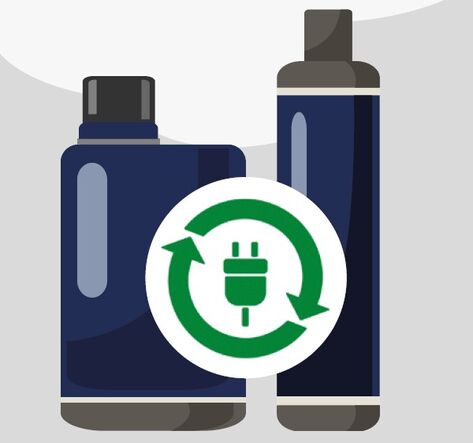
• Mark the collection box with the take-back logo (‘green plug’)
• Place the take-back logo clearly visible in the entrance area (min. A4 size)
• Also display the crossed-out wheelie bin symbol at the point of sale
Inform customers
The following information must be provided within the customer’s field of vision (ideally in the entrance area):
• Returns are free of charge and possible regardless of whether a new purchase is made
• Location and procedure for returns in the shop
• Used batteries must be handed in separately, provided they can be removed
• End users are obliged to dispose of them separately
• Retailers are obliged to accept returns
• Delete any personal data before handover
• Warning regarding the risks of lithium batteries
Sample text available for download (in german) HERE
Online-Retailers
Place the take-back logo in a clearly visible position in the online shop (before or during the ordering process)
• Offer a return option (e.g. return delivery or collection point)
• Provide information on correct disposal and return
Disposal of end-of-life equipment
• Handover by the retailer to local recycling centres (free of charge)
• Alternatively: Commission a service provider or use your own take-back system
Storage and Transport
• Do not store in escape or emergency routes
• Keep away from flammable materials and sources of ignition
• Secure damaged equipment separately
• During transport: Secure the load and carry a fire extinguisher (recommended)
Good to know: The administrative burden is minimal
• No registration required (exception: sale of own-brand products or equipment from unregistered manufacturers)
• No documentation or reporting requirements when handing over to a recycling centre or service provider
The take-back of waste electrical and electronic equipment is required by law.
Breaches of take-back or information obligations constitute an administrative offence and may be punished with fines of up to €100,000.
"Take care of the environment" campaign
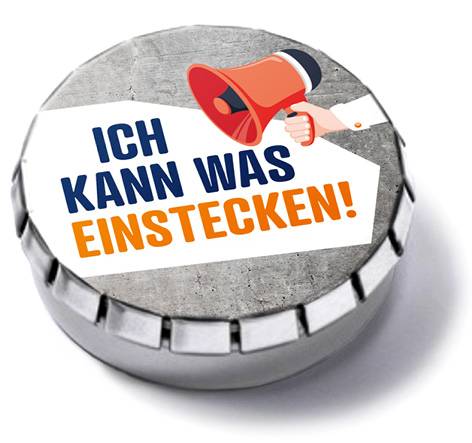
The campaign page with the same name provides detailed information on the causes and consequences of littering, measures to protect the environment and the installation and disposal of cigarette filters and e-cigarettes. It is possible to order handy pocket ashtrays, flyers and printed posters via a shop page. Since the BVTE environmental campaign began in 2020, thanks to numerous supporters, many of whom are volunteers, a total of almost one million pocket ashtrays, over 100,000 flyers and more than 1,500 posters have been distributed free of charge throughout Germany.
This is a great success! We would like to thank all committed environmentalists – private individuals, clean-up initiatives, cities and municipalities – for their active participation in creating a cleaner environment.
Waste in the environment affects the whole of society. Careless littering is often caused by thoughtlessness, a lack of awareness of the environmental pollution it causes and the offence committed, or simply a lack of disposal options. A single discarded cigarette may seem insignificant, but in total, cigarette waste is one of the most frequently discarded items in the world - and is becoming a problem.
The BVTE's "Mind the environment" campaign aims to help raise consumer awareness. After all, it is anything but sovereign to simply throw cigarette waste and rubbish anywhere in the environment. Waste should be disposed of responsibly in a rubbish bin or pocket ashtray.
E-cigarettes or caps/pods do not belong in household waste, but should be disposed of as electronic waste at a recycling centre or returned directly to a specialist retailer or the manufacturer. As a rule, rechargeable batteries, batteries or other components that contain harmful substances are labelled. The symbol of a crossed-out waste bin can be found on the devices themselves or on their packaging. Empty liquid bottles are household.
You can find all legal documents under “Regulations”.